
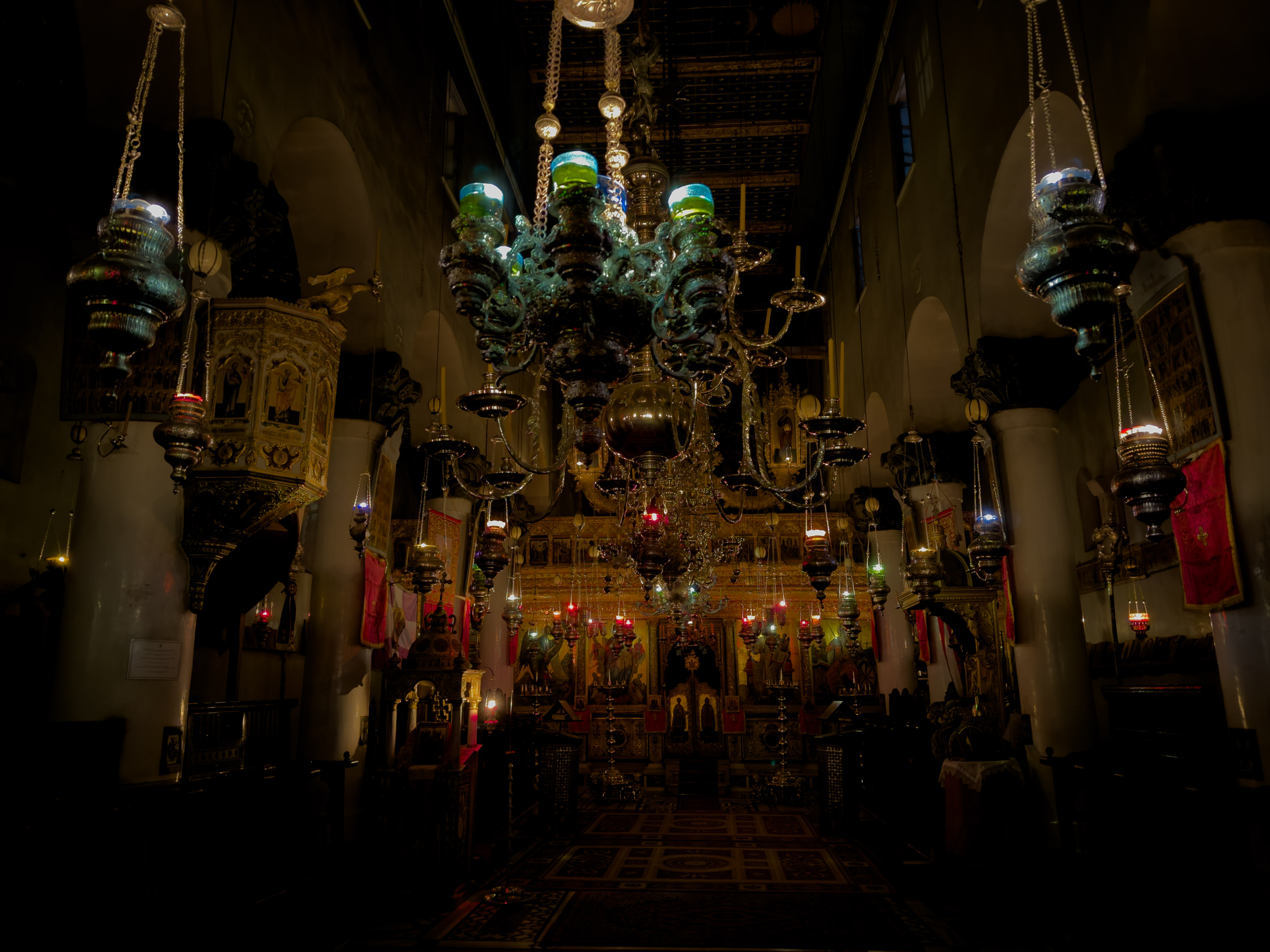
All the icon lamps are lit as we prepare to celebrate the feast of the Nativity of Christ. They are like multi-coloured stars floating just overhead.
|
||||
|
All the icon lamps are lit as we prepare to celebrate the feast of the Nativity of Christ. They are like multi-coloured stars floating just overhead.
Καὶ καλέσουσιν τὸ ὄνομα αὐτοῦ Ἐμμανουήλ, ὅ ἐστιν μεθερμηνευόμενον, Μεθ’ ἡμῶν ὁ θεός. And they shall call his name Emmanuel, which being interpreted is, God with us. (Matthew 1:23)
Detail, Menologion icon, ca. 1200 In December, the sun reaches its farthest point south, the winter solstice, and imperceptibly begins its return north.
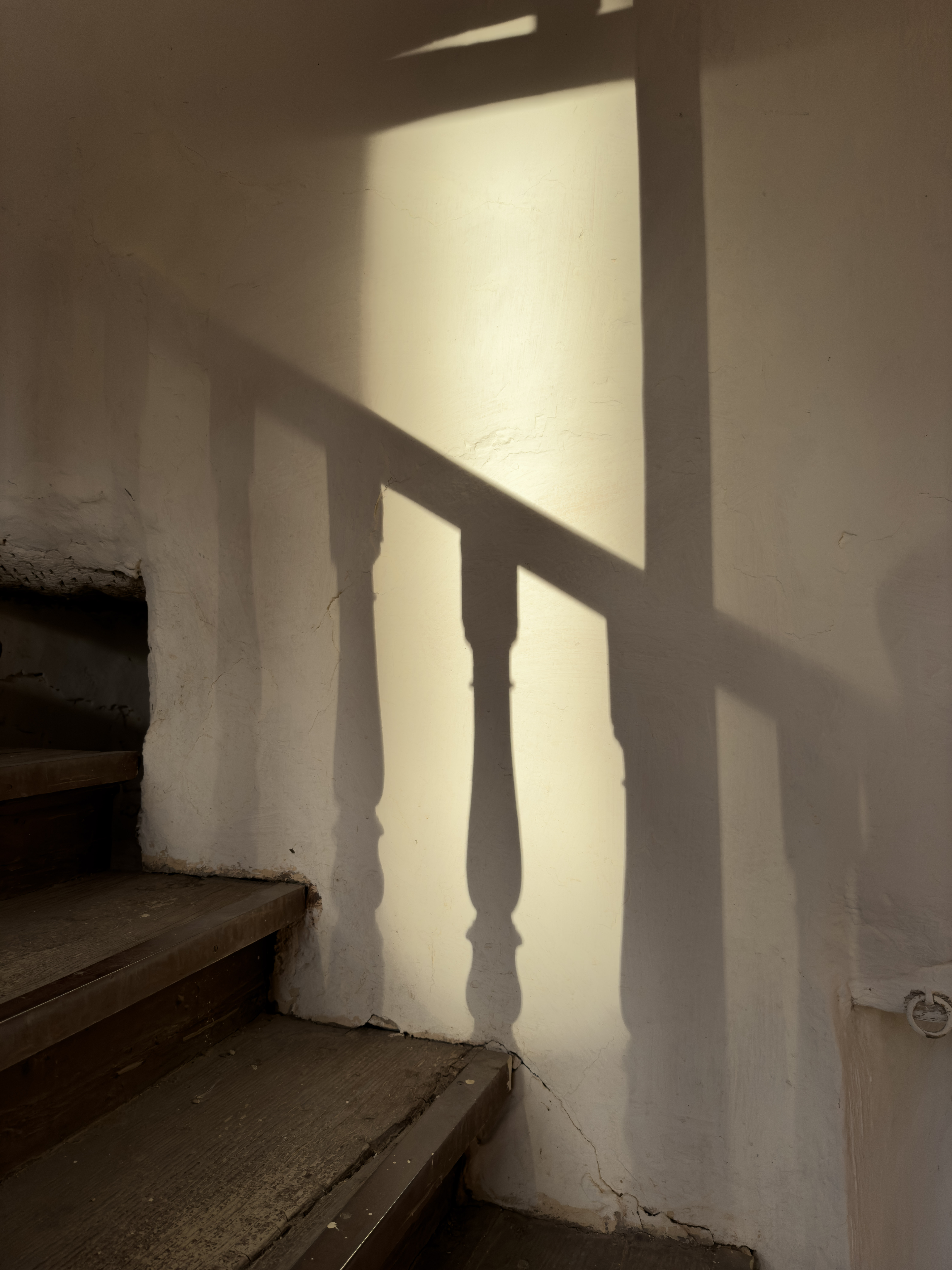
A stair rail casts a shadow in the first sunlight of a new day.
The icon of the Most Holy Theotokos on the iconostasion, at the beginning of Mesonyktikon, the Midnight Office. She is seated on a throne, and holds the Christ Child before her. He raises His right hand in blessing.
At the four corners of the throne are Prophets whose writings foreshadowed the Virgin Mary and the Incarnation. Solomon holds the house that Wisdom built (Proverbs 9:1), while Daniel holds the stone cut out from a mountain without hands (Daniel 2:34). Isaiah has the tongs that held the live coal taken from off the altar of God (Isaiah 6:6), while David holds a building and a scroll with the verse from the Psalms, Αὕτη ἡ κατάπαυσίς μου εἰς αἰῶνα αἰῶνος, ᾧδε κατοικήσω, ὅτι ᾑρετισάμην αὐτήν. ’This is my rest for ever: here will I dwell; for I have chosen her’ (Psalm 131:14 LXX).
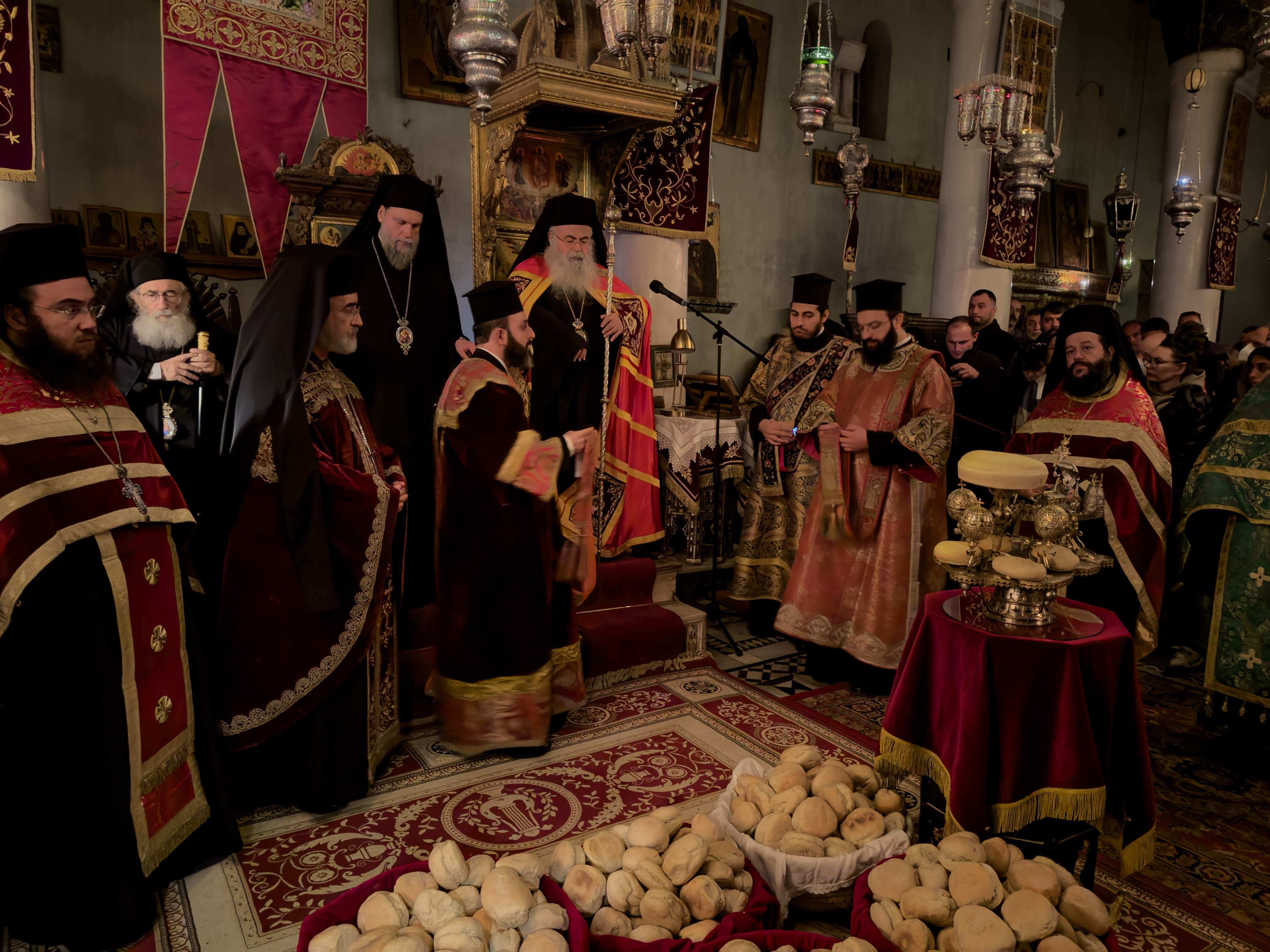
The icon was created by Ieremias Palladas in 1612. This year, Archbishop George of Cyprus visited Sinai for the feast of Saint Catherine, together with Metropolitan Gabriel of Nea Ionia (Church of Greece), and Archbishop Nicholas of Hermopolis (Patriarchate of Alexandria). Archimandrite Ieronymos, Patriarchal Exarch in Athens, represented the Patriarchate of Jerusalem. The church was filled with a multitude of pilgrims. Archbishop Damianos was present, but did not take part in the celebration of the Divine Liturgy, for reasons of health.
The Holy Table was adorned with Holy Gospels bound in metal, and silver ripidia.
All the lamps were lit over the reliquary of Saint Catherine, which was adorned with embroideries.
The blessing of the loaves at vespers. Each loaf was stamped with a seal depicting Saint Catherine.
Kolyva was offered in honour of the saint.
At the beginning of the Divine Liturgy.
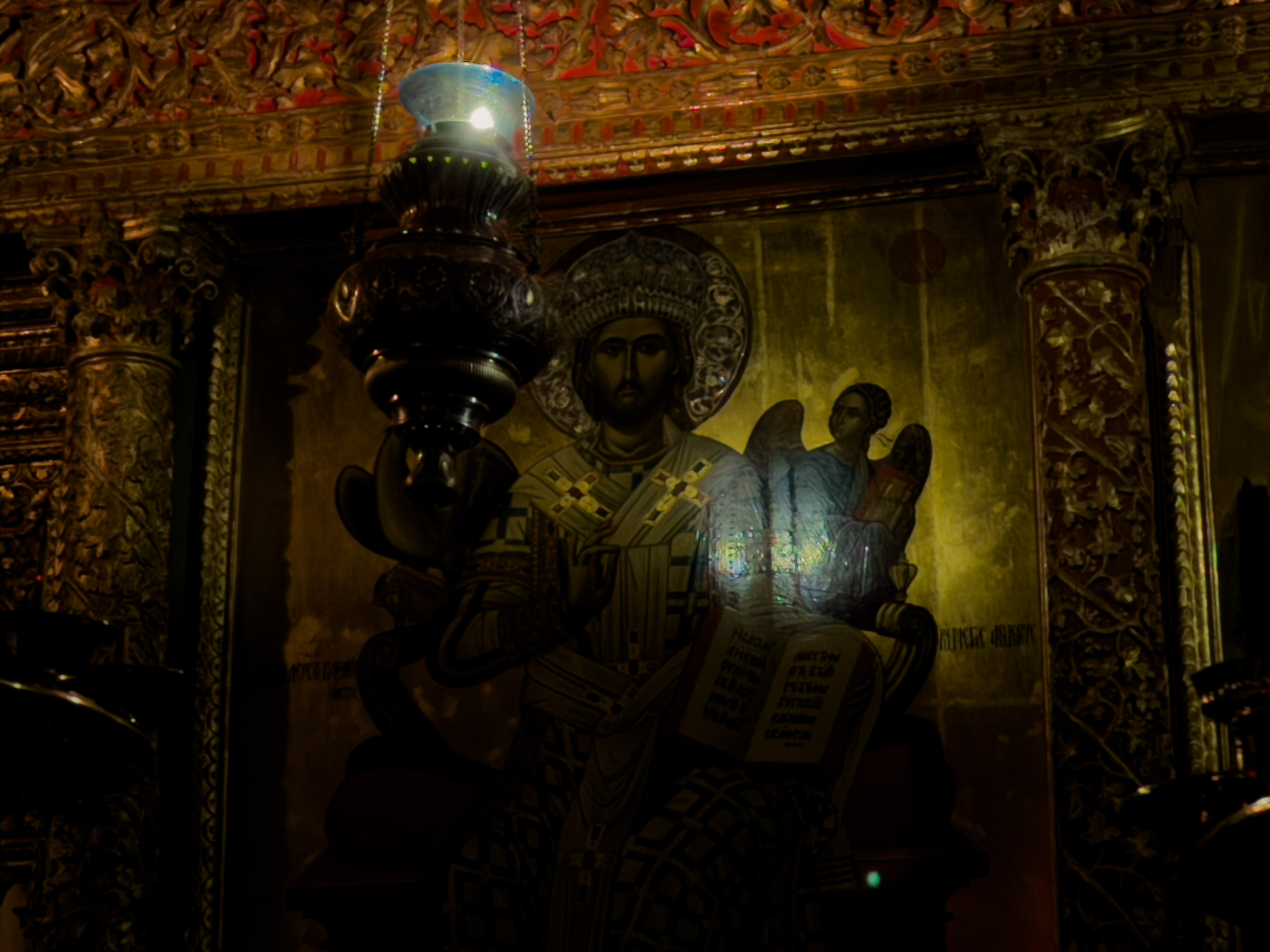
At the conclusion of the service, the relics of Saint Catherine were carried in procession around the church. Prayers were said for the members of the community, the pilgrims who had come for the feast, and for the members of the community who have gone to their rest. At four o’clock in the morning we begin Mesonyktikon, the Midnight Office. The icon of Christ on the iconostasion is lit by a single icon lamp. He is vested as the Great High Priest, and crowned as the King of Kings. At the four corners of His throne are the four living creatures beheld by the Prophet Ezekiel — the angel, the lion, the ox, and the eagle. In the early Church, these became symbols of the Four Evangelists.
On the final leaf of Greek 165, the scribe wrote two supplicatory prayers. The third inscription is a colophon that reads, Θεοῦ τὸ δῶρον Ἰωάννου πόνος Ῥόσου τὸ ἐπίκλειον, τάχα καὶ θύτου.
Sinai manuscript Greek 968 is an Euchologion copied by Bartholomaios Rhosos in Crete in 1426. In the colophon he signs himself τάχα καὶ ἱερέως. This is literally ‘perhaps even a priest’, but it has the meaning ‘perhaps not even worthy of the name of priest’. A θύτης is ‘a sacrificer, one who offers the sacrifice’. With the parallel above, we can translate τάχα καὶ θύτου literally, ‘perhaps even one who offers the sacrifice’, with the meaning ‘perhaps not even worthy of the name of one who offers the sacrifice’. We could then translate the colophon of Greek 165, ‘The gift of God a labour of Ioannis surnamed Rhosos, perhaps not even worthy of the name of one who offers the sacrifice’. Having written Greek 165 on his native Crete, Ioannis Rhosos emigrated to Italy where he created beautiful manuscripts of classical Greek texts for wealthy patrons in Rome, Florence, and Venice. He died in Italy in February, 1498. Sinai Greek 165 is a manuscript of the Four Gospels written on parchment in the middle of the fifteenth century. It is a small manuscript for personal reading, but it also contains rubrics to allow it to be used as a lectionary in the celebration of the Divine Liturgy.
The Gospel of Saint John ends on folio 421 recto, Ἔστι δὲ καὶ ἄλλα πολλὰ, ὃσα ἐποίησεν ὁ Ἰησοῦς, ἅτινα ἐὰν γράφηται καθ’ ἕν, οὐδὲ αὐτὸν οἶμαι τὸν κόσμον χωρῆσαι τὰ γραφόμενα βιβλία. Ἀμήν. ’And there are also many other things which Jesus did, the which, if they should be written every one, I suppose that even the world itself could not contain the books that should be written. Amen.’ (John 21:25) The scribe has tapered the text, with ornaments to either side, and written the concluding ‘Amen’ in the form of a cross. He then added, Τέλος τοῦ κατὰ Ἰωάννην ἅγιον εὐαγγέλιον, ‘The end of the holy Gospel according to John.’ Beneath this, he drew a cross as an interlocking knot. The oldest olive tree in the Sinai garden has been there for centuries. Its trunk has a massive girth. The oldest olive trees produce the best oil.
|
||||
|
© 2023 Father Justin's Blog - All Rights Reserved WP Support by WordPress Expert |
||||








Recent Comments